

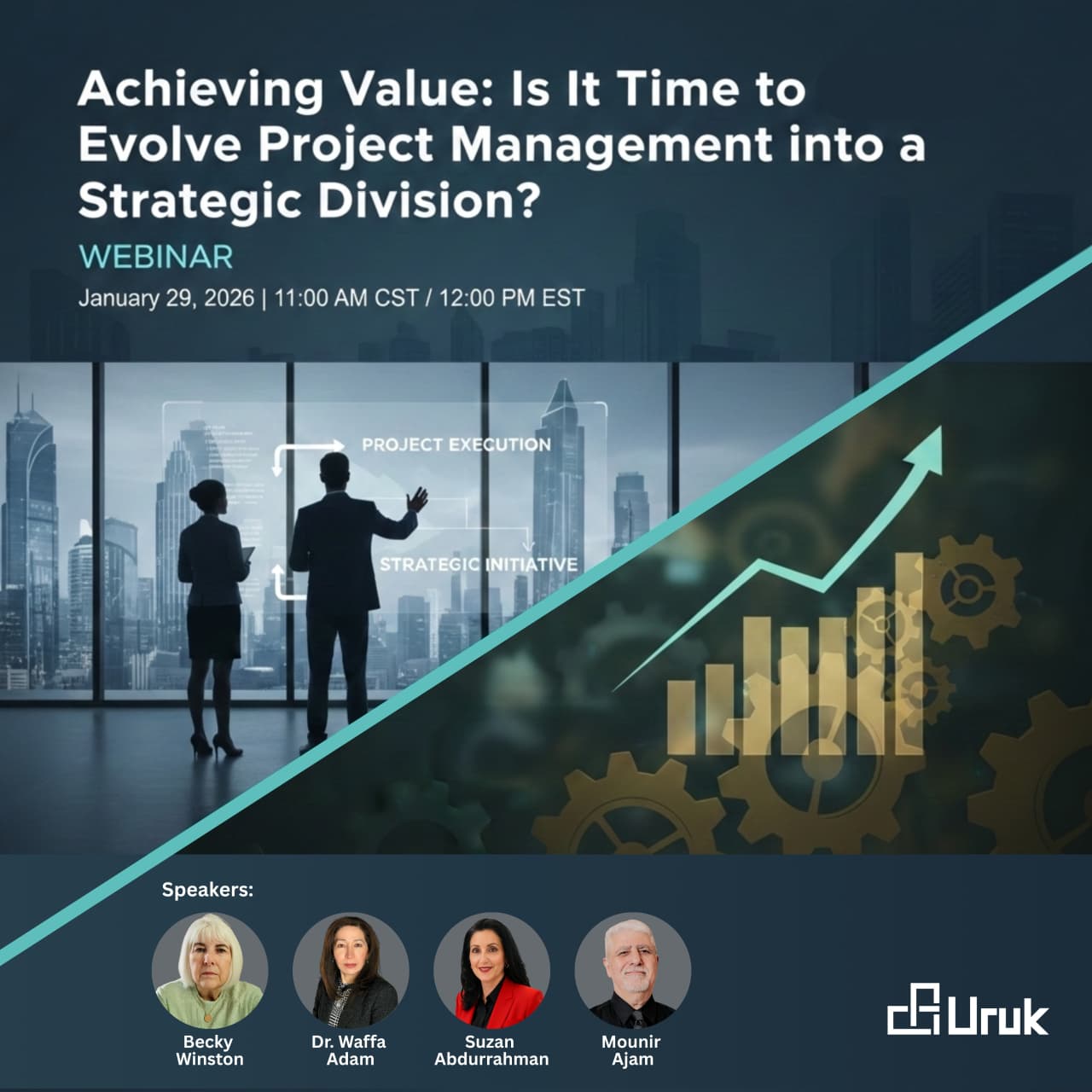
On January 29, 2026, Uruk Project Management hosted a webinar titled “Achieving Value: Is It Time to Evolve Project Management into a Strategic Division?” (Uruk) The conversation was candid by design: a practical examination of why many Project Management Offices (PMOs) still struggle to be seen as value creators, despite decades of investment in frameworks, certifications, tools, and process maturity.
This article is generated from that panel discussion and grounded in what we explored live: the persistent gap between the project management community and executive leadership, the structural constraints that keep PMOs operating with limited mandate, and what it actually takes for project management to become a governance-level capability rather than a reporting function.
Who this is for
If you are a CEO, COO, CIO, head of transformation, PMO leader, portfolio leader, or an executive sponsor accountable for strategic outcomes, this is for you. It is also for experienced project and program professionals who feel the tension between “doing the work” and being empowered to shape the work.
The thesis is straightforward: strategy does not create value until execution creates outcomes, and execution does not scale without an empowered structure that can govern priorities, resources, performance, and trade-offs.
The panel and why their perspectives matter
I had the privilege of facilitating a discussion with three experienced leaders who approach the topic from different angles:
- Becky Winston, PMI Fellow, former Chair of the Project Management Institute, and President of the College of Performance Management.
- Dr. Waffa Adam, Managing Director of Global PMO Solutions, PMI Fellow, has deep experience in enterprise IT execution, portfolio leadership, and PMO transformation.
- Suzan Abdurrahman, an enterprise execution and PMO transformation leader focused on the governance gap: organizations expecting PMOs to deliver outcomes without authority, decision rights, or accountability levers.
The starting point: PMOs are everywhere, yet success rates remain inconsistent
The webinar description captured a reality many organizations recognize: PMOs have “long been the anchor” for governance and alignment, yet “project success rates remain unacceptably low,” and PMOs are often perceived as overhead due to narrow mandates and limited authority.
That framing matters because it exposes a contradiction that executives feel sharply:
- “We funded a PMO.”
- “We adopted templates, stage gates, and dashboards.”
- “We trained people and bought tools.”
- “So why are outcomes still inconsistent?”
This is where the conversation moved beyond PMO mechanics and into organizational design.
The hidden battle: the credibility gap between project teams and executives
Early in the discussion, I raised what I called the “hidden battle.” Project professionals often ask for a seat at the table, more sponsorship, and greater empowerment. Executives look at delivery variance, missed benefits, and broken commitments, and respond, implicitly or explicitly: trust must be earned.
Becky’s response was direct and, in my view, highly practical. She argued that part of the gap is self-inflicted: we are not consistently our own best advocates, and we often avoid honest reporting because we fear what transparency will trigger. Her point was not “be negative.” It was “be credible.”
A short line from the conversation captures the issue: we want everything to look “beautiful,” and that harms us because credibility erodes when reality eventually surfaces.
Waffa extended this by naming what many PMs experience daily: a culture where yellow triggers panic and red triggers punishment. In that environment, dashboards become performance theater. The PMO may exist, but truth does not flow upward, and governance becomes ceremonial rather than corrective.
Suzan offered a counterbalance that is equally important: communication alone does not solve a structural problem. If the organization sets up the PMO as a service desk for projects, with accountability for outcomes but without authority, then even excellent communication will hit a ceiling.
This is the first major takeaway:
You cannot close an executive credibility gap with reporting. You close it with a governance model that produces better decisions earlier, using truth as an input, not an exception.
The “service provider” debate: helpful framing, or self-limiting label?
A surprisingly powerful moment emerged around one word: service.
Suzan challenged the idea of the PMO as a “service provider,” especially when it is buried several layers under IT or operations. Her argument is that the label signals subordination: “support” rather than “decision.” When organizations adopt that framing, they should not be surprised when PMOs are treated as overhead.
Becky introduced a stronger positioning: PMOs, at their best, are “enablers” of strategy and operations. Not in a motivational sense, but in a functional sense: if strategy requires coordinated execution, then the function that orchestrates execution is not optional.
Waffa provided a pragmatic bridge: yes, a PMO can operate with a service model (especially in consulting-influenced environments), but being a service provider should never mean being low value. The issue is not the word itself; it is what the word permits executives to withhold: mandate, decision rights, and empowerment.
Here is the nuance that matters for leaders:
- If your PMO is delivering tools, templates, reporting, coaching, and coordination, you may be buying “support.”
- If your organization needs strategic execution excellence, you must design for “governance.”
Those are not the same.
A point to ponder:
Should PMOs and project management be viewed and treated as a service provider or as a partner?
Why we cannot even define PMO consistently, and why that weakens outcomes
We also confronted a persistent industry challenge: PMOs come in many “flavors.” Some are project control offices. Some are talent pools for project managers. Some manage standards and training. Some own portfolio governance. Some do a bit of everything without the authority for any of it.
Becky made a critical point: if there is no consistent definition, then there cannot be consistent success criteria. Executives frequently believe they “have a PMO,” but what they actually have is a reporting team with limited scope. Then the organization measures it against outcomes it was never designed, staffed, or empowered to deliver.
Suzan sharpened this into a governance argument: a PMO cannot be expected to stop low-value projects, enforce strategic alignment, or kill initiatives with poor ROI if it does not have the authority to do so. She said it plainly during the conversation: sponsors often do not want to pull the plug on their own projects, and without a neutral governance mechanism, weak initiatives persist until damage is unavoidable.
Waffa added an important comparison: other corporate functions, like finance, are empowered to make hard calls. Most organizations do not debate whether finance has authority. They debate how finance should exercise it. That contrast should make leaders uncomfortable, because it reveals a design bias: execution governance is treated as negotiable, while financial governance is treated as mandatory.
The real question: do we keep patching PMOs, or evolve the function?
At this point, the discussion moved from “improve the PMO” to a deeper question: are we unintentionally limiting ourselves by accepting the idea that project management is an “office,” while other functions are divisions or business units led by executives?
That question aligns with Uruk’s broader point of view: organizations achieve resilience and measurable value when project management is embedded as a strategic business function, not confined to a support layer.
This does not mean every organization must create a new C-level role tomorrow. But it does mean this:
If execution is how strategy becomes real, then execution needs governance-level design.
In Uruk’s language, the aim is to “bridge vision to achievement” by integrating governance, success models, and performance management into how organizations operate.
Education is a lever, but it is not fast enough on its own
One thread that resonated strongly was education.
Becky argued that many executives, including MBA graduates, have limited exposure to project management as an execution discipline. Project management is often treated as an elective, or segregated into IT or construction tracks, rather than embedded into core business education. That leaves senior leaders underprepared to govern the work that actually produces change.
Suzan suggested a practical distribution model: do not expect executives to attend project management conferences. Bring the message into executive ecosystems (for example, major executive forums), but do it as education, not marketing.
Becky challenged professional associations directly: participation in high-profile executive venues is not enough if the content is primarily promotional rather than instructional. That critique matters because the industry often confuses visibility with influence.
Waffa offered a “just-in-time” reality: even if universities evolve, generations of leaders will continue to rise through organizations without foundational training in execution governance. Organizations, therefore, need targeted leadership education that makes project management understandable, governable, and measurable.
The second major takeaway:
Education builds long-term capability, but governance design is the near-term differentiator.
What mandate and authority are actually required to deliver value?
Near the end of the webinar, I asked a direct question: What structure, mandate, and authority are required to consistently deliver organizational value?
The answers converged on a simple model:
- Visibility across portfolios, priorities, resource constraints, and delivery realities. Not just reporting, but real transparency that enables decision-making.
- Authority or empowerment to enforce alignment, set standards that matter, intervene early, and stop initiatives that no longer justify investment.
- Communication capability that equips project leaders to engage executives with clarity, credibility, and decision-grade insights.
- People systems that build capability over time: career paths, mentoring, coaching, and talent standards, not only templates and tools.
Becky emphasized that “soft skills” (or “power skills,” as some now call them) are often among the hardest skills to acquire, yet they are under-taught, especially for executive-facing communication.
Waffa reinforced the organizational reality: if the PMO does not own talent management for project roles, HR will, and HR may not understand the difference between course attendance and competence development.
Suzan brought it back to governance: visibility without authority is information without leverage. Authority without visibility is power without intelligence. You need both.
A practical blueprint for organizations considering the shift
Based on the discussion, here is a pragmatic blueprint leaders can use to assess whether their PMO model is sufficient or whether they are ready to evolve project management into a strategic division.
1) Clarify what your PMO is and what it is not
Start with a definition inside your organization. What services does it own? What decisions does it influence? What outcomes is it accountable for? If there is a gap between accountability and authority, name it explicitly.
2) Establish decision rights, not just processes
If you want alignment, you need decision rights that allow the function to challenge priorities, enforce gates, and stop work that fails strategic or value criteria. Otherwise, you are managing paperwork, not execution.
3) Integrate execution with governance cadence
Executives do not need more dashboards. They need a governance cadence where portfolio trade-offs are made routinely, using truthful delivery signals and benefits signals, not optimism.
4) Build the people system alongside the process system
Templates do not create competence. Career paths, mentoring, coaching, and standards do. This includes executive communication as a core skill, not an optional trait.
5) Make “value” operational
Value cannot remain a slogan. It must be translated into how initiatives are selected, funded, monitored, course-corrected, and, when necessary, terminated.
Closing thought: value is not a PMO output; it is an organizational design outcome
The webinar’s description called this a discussion about “structure, mandate, and the future of execution excellence.” That phrasing is accurate because the PMO challenge is rarely a tooling problem. It is a design problem.
When organizations treat execution governance as optional, they get optional outcomes. When they treat project management as a strategic business function, aligned to governance and empowered to act, they get a system that can reliably convert intent into impact.
At Uruk, this is central to our mission: helping organizations reduce costs, accelerate delivery, and improve success rates by embedding project management as a strategic business function.
My thanks again to Becky Winston, Dr. Waffa Adam, and Suzan Abdurrahman for an honest, high-substance conversation. If you are a leader responsible for strategy, transformation, or enterprise performance, the question is not whether you have a PMO. The question is whether your execution model is designed to achieve value.
About the Author
Mounir A. Ajam is the Founder & CEO of Uruk Project Management and a leading voice in evidence-based project management. He is the creator of the Uruk Framework and a passionate advocate for transforming how organizations define and achieve success.