One more chapter to post from our upcoming e-book series on the PMBOK® Guide before the books are published and are ready for downloads.


One more chapter to post from our upcoming e-book series on the PMBOK® Guide before the books are published and are ready for downloads.
In a previous article, we discussed a few gaps in the PMBOK® Guide. That topic is a chapter in an upcoming e-book on how the guide current reality. In another e-book, we discuss improvements to the guide; this article is a chapter in this second e-book.
In a previous article, we discussed a few inconsistencies in the PMBOK® Guide. That topic is a chapter in an upcoming e-book on how the guide current reality. In another e-book, we discuss improvements to the guide; this article is a chapter in this second e-book.
What is the PMBOK® Guide Current Reality? This topic is the subject of our first e-book on the Guide, part 1 of 2-book series. What are the inconsistencies in the PMBOK® Guide is a chapter in this first e-book.
What is the PMBOK® Guide Current Reality? This topic is the subject of our first e-book on the Guide, part 1 of 2-book series. What is not emphasized enough in the PMBOK® Guide is a chapter in this first e-book.
What is the PMBOK® Guide Current Reality? This topic is the subject of our first e-book on the Guide, part of 2-book series. What is Missing from the PMBOK® Guide is a chapter in this first e-book. We also wrote about this in the past.
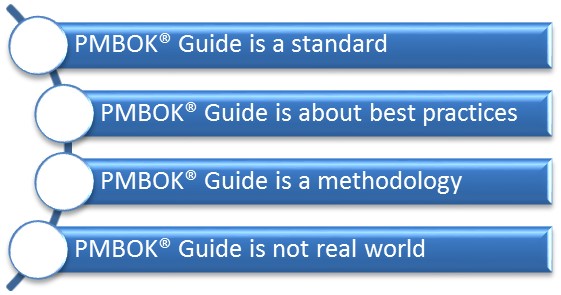
What is the PMBOK® Guide Current Reality? This topic is the subject of our first e-book on the Guide, part of 2-book series. The Four Myths is a chapter in this first e-book.
In this blog post we present a chapter from a 2-book series (e-books) that we are working on, PMBOK® Guide – Part 1 – Current Reality. This post focus on the historical perspective.
Once the Human Resource manager for a client, a construction company, asked me “Mounir, I thought project management is only for construction but my friend is an HR manager in a jewelry company and she just attended the class your company did for them.”
The world of project management is quite wide these days. There are projects in different types of organizations, from a variety of industries, and are of varying size or classification. Should we manage them all the same way?
Sitemap
Knowledge